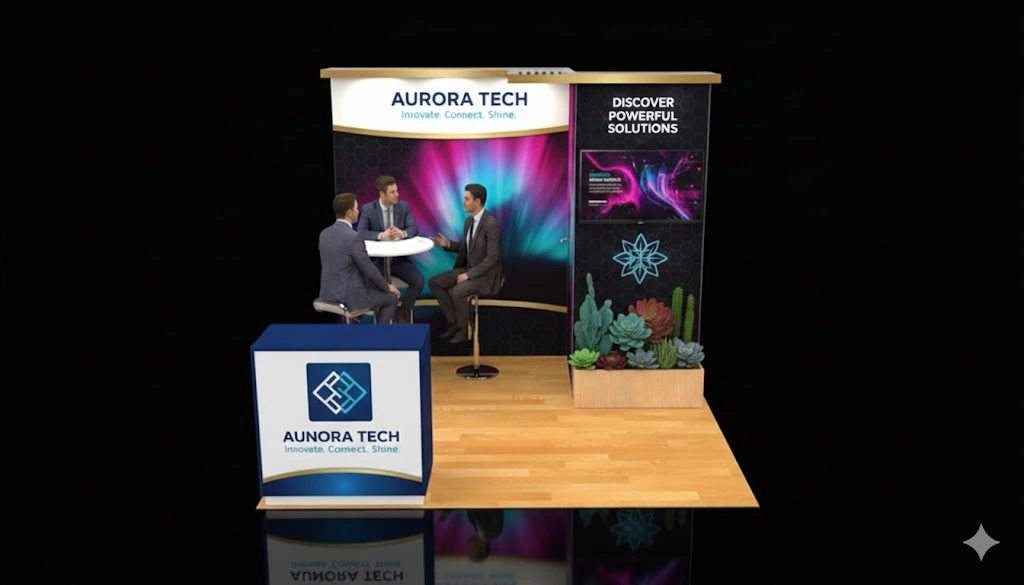
Anyone who has walked the aisles at the Orange County Convention Center in Orlando knows that most exhibitors are working with a 10×10 space. It is the most common booth size in the industry, which means your small footprint sits right next to dozens of others that look almost identical. A good small exhibition booth design is what gets a visitor to slow down at yours, and the choices behind it are usually simpler than people expect. At Orlando Exhibit Rentals, we set up 10×10 booths for companies of every size, and our 10×10 trade show booth rental packages cover the structure, graphics, lighting and installation in one order.
Why a 10x10 Booth Needs a Different Design Approach
A 10×10 booth gives you 100 square feet of floor space, usually with an 8-foot-tall back wall and shorter side walls of around 3 feet. That is enough room for a counter, a screen, a few products and two or three staff members, but only if every item has a job. Crowding in extra furniture, brochure racks and banners makes the booth look busy rather than professional, and visitors tend to walk past a space that looks cluttered.
The better approach is to decide what the booth has to accomplish before choosing a single graphic. A booth built to collect leads is laid out differently from one built to demo a product or one built to show off a brand at a large industry show. Once that goal is clear, the rest of the design decisions become much easier.
Small Trade Show Booth Design Ideas That Work
1. Build the booth around one clear message
Attendees read a booth from the aisle, usually from 15 to 20 feet away and often while walking. At that distance they will take in a short headline, a logo and maybe one image. A back wall that tries to explain every service you offer will not be read. Pick the one thing you want a stranger to understand about your company, state it in large type, and let the staff cover the details in conversation.
2. Use the height you are allowed
Because floor space is limited, vertical space becomes your most valuable asset. A tall back wall with a large tension fabric graphic puts your brand above the heads of the crowd, so people see it from further down the aisle. Many shows also permit a hanging sign or tower over a 10×10 inline booth, although rules vary a lot between venues, so read the exhibitor manual before you design around one.
3. Keep the front of the booth open
Tables placed across the front of a booth work like a barrier. They tell visitors that stepping inside is a commitment and that a sales conversation is waiting. Moving the counter to one side or to the back corner creates an open entrance, and people are far more willing to walk in and look around when nothing is blocking them. Staff can then stand beside or slightly in front of the counter and speak to people as they approach.
4. Choose lighting that gets noticed
Convention halls are lit evenly and quite flatly, so a booth with its own lighting stands out right away. Backlit fabric walls, LED strip lighting along counters and focused spotlights on products all help draw the eye. Warm, even light on your featured product also makes it look better in photographs, which matters when attendees post pictures from the floor.
5. Add one screen, not three
A single well-placed monitor playing a short looping video does more for a small booth than several screens competing for attention. Keep the video silent or low in volume, add captions, and make the first few seconds visually strong. Screens work best when they show the product in use, since people can understand something in a few seconds of footage that would take a paragraph to explain.
6. Let the product take center stage
If you sell something physical, display it at eye level and give each item some breathing space. Wall niches, a pedestal or an illuminated shelf lets you show a few pieces properly instead of covering a table with everything. For software or services, a demo station with a tablet or touchscreen gives visitors something to do, and people who interact with a booth stay longer.
7. Plan the floor, too
Flooring is often ignored in 10×10 booths, but a branded or colored carpet tile or a raised floor tells the visitor where your space begins and marks the booth out from the neutral aisle carpet. It also makes a long day easier on your team, which is worth thinking about.
8. Include storage you cannot see
Boxes, bags and spare literature under a table cloth tend to show. A rental counter with a lockable cabinet or a back-wall storage closet keeps personal items and extra stock out of sight and keeps the booth tidy through three days of a show.
10x10 Booth Layout Ideas
The layout decides how people move through your space, so it deserves as much thought as the graphics. These are the options we see most often.
Straight-line (inline) layout. The standard setup, with the back wall facing the aisle and side walls shared with neighboring booths. A counter sits to one side or across the middle, and a display or screen goes on the back wall. This works well for most shows and is easy to staff.
L-shaped layout. Counters or display units form an L along the back and one side, which leaves the front corner open. It gives you a natural spot to greet visitors and keeps a small demo area close to the entrance.
U-shaped layout. Counters or display walls run along three sides, creating a small pocket that draws visitors in. It suits product-heavy exhibitors, although you should leave a clear walking path so the booth does not feel closed in.
Corner booth layout. A 10×10 on a corner has two open sides, so it is visible from two aisles. Graphics can wrap around both exposed sides, and the added visibility is often worth the higher space fee charged by the show.
Open-center layout. Keeping the middle of the booth empty and putting everything against the walls gives staff and guests room to stand and talk. It is a good choice when conversation matters more than product demonstrations.
Renting a 10x10 Booth Instead of Buying
For many small and mid-sized exhibitors, a 10×10 trade show booth rental makes more practical sense than owning a display. Rentals mean you are not paying to ship, store and repair a booth between shows, and you can change the design for each event rather than reusing the same graphics for years. A rental also helps when your show schedule is uncertain, since you are only paying for the events you attend. If a 10×10 starts to feel tight once you add a demo area and seating, a 10×20 trade show booth lets you give each of those its own space.
When you compare rental options, ask what is included. A good rental package covers the structure, the graphics, lighting, counters, installation and dismantle, and often the flooring, so that you are not assembling the pieces from different suppliers. It also helps to work with a company that is local to the show city. Orlando Exhibit Rentals is based in Orlando, which means installation teams are close to the convention center and last-minute changes can be handled quickly instead of through a long-distance shipping delay.
Common Mistakes in Small Booth Design
- Too much text. Small types and long paragraphs cannot be read from the aisle.
- Low-resolution graphics. Images that look fine on a laptop can look blurry at wall size, so always use files prepared for large-format printing.
- Ignoring show rules. Height limits, hanging sign restrictions and electrical requirements differ between shows and can force changes late in the process.
- Too much furniture. Four chairs and a table take up a large share of a 100-square-foot space.
- Weak branding at eye level. The area between waist and head height is where most people look first, so keep key content there.
- Leaving the design to the last week. Custom graphics, electrical orders and shipping all need time, and rushed work shows in the result.
A Quick Planning Checklist
- Define the main goal of the show: leads, product demos, brand awareness or sales.
- Confirm the booth size, location and the exhibitor manual rules.
- Choose a layout that fits that goal and the number of staff you will have.
- Write one short headline for the back wall and select a single strong image.
- Decide on a counter, a screen and a product display, and leave out everything else.
- Plan lighting and flooring.
- Order graphics and rental items several weeks ahead of the show date.
- Brief your staff on how to greet visitors and where to stand.
Final Thoughts
A small booth does not need a large budget to make an impression. It needs a clear message, a layout that welcomes people in, good lighting and graphics that can be read from a distance. If you are planning an upcoming show in Orlando or anywhere else in the country, the team at Orlando Exhibit Rentals can help you pick a 10×10 booth rental and a design that fits your goals, your schedule and your space. Send us the details of your show and we will put together a proposal for you. Send us your show dates and booth size and we will request a quote on your behalf, or you can contact our Orlando team directly to talk through the options.
Frequently Asked Questions
What can you fit in a 10x10 trade show booth?
Most exhibitors fit a counter or reception desk, a back wall with graphics, a monitor, a small product display and two or three staff members. Adding a small seating area is possible, but it limits the space left for walking in.
How much does a 10x10 trade show booth rental cost?
Pricing depends on the design, the graphics, the lighting and furniture you include, and the installation required for the venue. A simple rental package costs much less than a fully custom design, so the best way to get an accurate figure is to request a quote based on your show and booth requirements.
What is the best layout for a 10x10 booth?
An open inline layout with the counter positioned to the side is the safest choice for most exhibitors. If your booth is on a corner, wrapping graphics across both open sides takes better advantage of the extra visibility.
How do I make a small booth look bigger?
Use light colors, keep the front open, add lighting to the back wall and avoid filling the space with furniture. Tall vertical graphics also make the booth feel larger than its footprint.
Should I rent or buy a 10x10 booth?
Renting suits companies that attend a few shows a year or want a fresh look each time, while buying tends to make sense for companies exhibiting at many shows with the same setup. Costs for storage, shipping and graphic updates should be included in any comparison.
Can I customize a rental booth?
Yes. Most rental companies, including Orlando Exhibit Rentals, offer custom graphics and different wall, counter and lighting options so the booth reflects your brand rather than a generic template.
CONTACT US
AND AN EXHIBIT EXPERT WILL GET BACK TO YOU SHORTLY!
